

What if your whole story lived in one beautiful tree—roots and all?
At Creative Fox Counseling Center, we use a gentle, arts-based practice called the Tree of Life to help you see your strengths, supports, hopes, and next brave steps—without minimizing the storms you’ve weathered.
This is a narrative and expressive arts activity designed to help you assess where your strengths lie and how your choices could impact your future best Self.
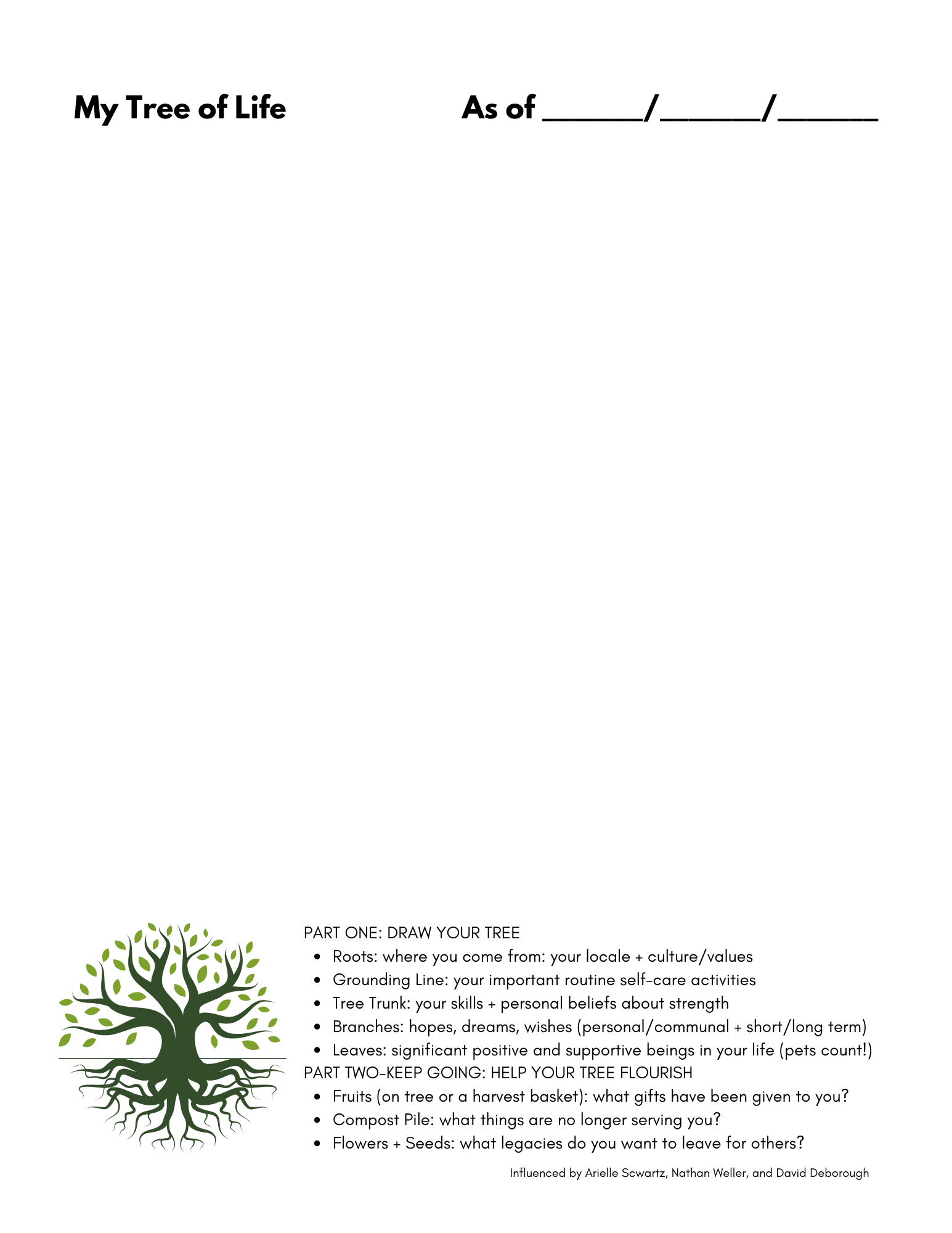
Start with a blank piece of paper (even the back of a bill will do!) or feel free to download and print our worksheet.
Set The Tone
Before you draw, pause and ground:
- Quick body check with your nervous system:
- Watchdog (fight/flight): “Any part of me on alert right now?”
- Wise Owl (ventral/regulated): “Where do I feel clear and steady?”
- Possum (freeze/shutdown): “Any spots that feel numb or heavy?”
Notice, name, and offer your parts a little care from Self—the steady, compassionate core inside you.
Part One: Get Paper and Draw A Grounding Line
Grab our printable our use any blank paper — draw a line that separates above ground from underground.
Roots — Where you come from
Draw the roots and write places, cultures, family stories, values, and early teachers (grandparents count; pets do too if they shaped you!).
Add a favorite memory or two–a place/food/smell? If a root feels tender, put a tiny heart beside it.
Grounding Line — Your everyday supports
Flush out the ground your tree stands on: routines, places, and practices that keep you steady (morning coffee on the porch, the trail at the park, meds, meetings, prayer, playlists).
If life’s terrain feels bumpy, draw it bumpy—truth first, fixes second.
Trunk — Skills + Strength Beliefs
Draw a tree trunk coming from the roots: write words that show what you’re good at inside the trunk: creativity, humor, crafting, boundary-setting, asking for help, advocating for others. Add words you wish were true about you—aspirational bark still protects.
Branches + Twigs — Hopes, Goals, and Tiny Next Steps
Branches (growing from the tree) are your big hopes and focus areas (personal + communal, short + long term).
Write a word or short phrase on each branch.
Twigs are the doable, bite-size actions that grow from each branch.
Pick 2-4 branches that represent currently important goals and draw some immediate next steps for those goals
Leaves — People + beings who support you
Create leaves growing on branches: write first names (or initials) on leaves: friends, kids, ancestors, mentors, clinicians, neighbors, pets.
Part Two: Help your tree flourish
Fruits — Gifts you’ve received
Draw fruit on the tree: they represent gifts you’ve been given. A scholarship, a second chance, a new coping tool, a neighbor’s casserole, a judge’s moment of fairness, a therapist’s question that landed. Label the fruit.
Compost Pile — What no longer serves
Draw a pile or bin: add the beliefs, habits, or roles you’re ready to break down: overfunctioning, perfection, “I have to do it alone,” doom-scrolling, people-pleasing, minimizing harm.
Flowers + Seeds — Legacy and impact
What do you hope to plant for others? Draw them as flowers and seeds. Safer systems for families, a creative practice your kids inherit, a scholarship fund, a community altar, a more trauma-informed workplace, weekly kindness toward your own nervous system.
Meaning-making: questions for reflection
- Which root surprised you by how strong it felt?
- Where is the Watchdog over-working, and what new boundary could lighten its load?
- What tiny daily action would thicken one branch this month?
- Which leaf needs a thank-you text? Which compost item wants one respectful goodbye ritual?
- If Wise Owl picked one seed to guard this season, which would it be?
Closing
When you’re done, date your page and take a photo. Trees are living things—so are you. Revisit this practice each season to notice what’s growing, what’s ready to compost, and what still wants sunlight. If you’d like to do a guided Tree of Life session (individual, family, or group) with Creative Fox, we’re here to help you cultivate a calm, creative nervous system and a life that feels like you.
Acknowledgments: Adapted from the Tree of Life approach by Ncazelo Ncube (REPSSI) and David Denborough (Dulwich Centre Foundation), and inspired by the clinical writing of Dr. Arielle Schwartz and others who integrate trauma-informed, strengths-based care.